Quick Answer
- Iguanas need two different things from their lights: UVB, so their skin can make vitamin D3 and they can absorb calcium, and heat, for a hot basking spot.
- A long linear UVB tube (typically a T5 high-output tube of around 10 to 12 percent UVB) covering much of the enclosure is the usual choice for iguanas.
- Run the lights about 12 hours a day on a timer, with darkness at night.
- UVB does not pass through ordinary glass or plastic, and mesh reduces it. Follow the manufacturer's distance guidance, ideally checked with a UV index meter.
- Replace UVB lamps on the manufacturer's schedule, often 6 to 12 months depending on the type, even if they still glow.
Why Iguana Lighting Matters
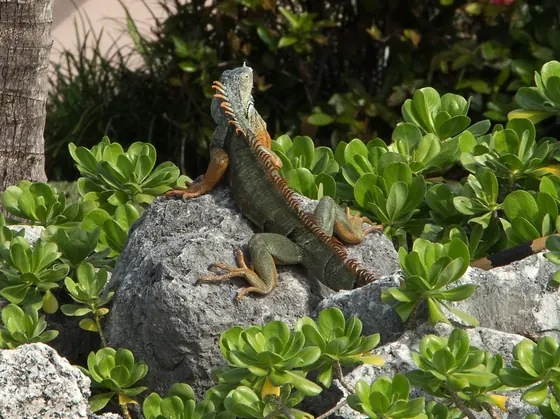
In the wild, green iguanas bask in strong tropical sunshine for hours. Sunlight gives them heat to reach their working body temperature and ultraviolet B (UVB) light, which their skin uses to make vitamin D3. Vitamin D3 lets the gut absorb calcium from food. Indoor iguanas get neither unless their keeper provides them.
When UVB is missing, too weak or blocked, an iguana cannot use dietary calcium properly, even on a good diet. Over months this can lead to metabolic bone disease, one of the most common serious problems in pet iguanas, with soft or deformed bones, swollen limbs, tremors and fractures. Too little heat causes problems too: a cold iguana cannot digest food well and its immune system works poorly.
A good setup copies the sun in a simple way: bright light, heat and UVB from above at the basking spot, with cooler, dimmer areas the iguana can move to.
UVB, UVA and Heat: What Each One Does
| Light | What it does | Typical source |
|---|---|---|
| UVB | Lets the skin make vitamin D3, which is needed to absorb and use calcium | Linear UVB tube (T5 or T8) or a UVB-producing mercury vapor bulb |
| UVA | Part of normal vision; iguanas can see UVA, which may affect behavior, feeding and social signaling | Most reptile UVB lamps and halogen bulbs also emit some UVA |
| Visible light | Sets the day-night rhythm and lets the iguana see and feel secure | UVB tube, basking bulb, daylight-type LED lighting |
| Infrared and heat | Warms the basking spot so the iguana can reach its preferred body temperature | Halogen flood bulb, incandescent basking bulb or mercury vapor bulb |
Choosing a UVB Light for an Iguana
Linear T5 and T8 Tubes
Linear fluorescent tubes are the standard UVB source for iguanas because they spread UVB along a long section of the enclosure instead of one small spot. T5 high-output (HO) tubes are thinner and stronger than older T8 tubes, so they reach further and usually last longer. Many keepers of iguanas use a T5 HO tube rated around 10 to 12 percent UVB, often with a reflector, mounted across the top of the enclosure above the basking area. In very tall or large enclosures, more than one tube may be needed.
The percentage on the box is not a direct measure of strength. It describes the share of the lamp's output that is UVB, and the actual amount reaching your iguana depends on the tube type, reflector, distance and anything in between. Choose the tube length to cover a large part of the enclosure, as the last inch or two at each end produces less UVB.
Mercury Vapor Bulbs
Mercury vapor bulbs produce heat, visible light and UVB from a single screw-in bulb. They can work in large enclosures and rooms, but they create a strong, concentrated hot spot, need a ceramic socket and must be placed at the distance the manufacturer gives. They also cannot be run on a dimming thermostat, so the basking temperature has to be managed by distance.
Compact and Coil UVB Bulbs
Small compact or coil UVB bulbs cover a narrow area and are generally considered too weak and too localized for a large lizard like an iguana. They are not a good primary UVB source.
What Is Not a UVB Light
Ordinary household bulbs, standard LEDs, plant grow lights, aquarium lights and lamps labeled only "full spectrum" or "daylight" do not provide useful UVB unless the packaging states UVB output for reptiles. Read the label carefully.
How Far Should a UVB Light Be from an Iguana?
UVB weakens quickly with distance, so placement is as important as the bulb. There is no single correct distance, because it depends on the lamp, the reflector and whether the light shines through mesh. As general guidance:
- Follow the manufacturer's recommended distance from the basking surface for your specific lamp.
- Mount the lamp inside the enclosure where possible. A mesh screen between the lamp and the iguana can block a large share of the UVB, so mesh-mounted lamps usually need to be closer or stronger.
- Never shine UVB through glass, acrylic or a plastic lamp cover. These block most UVB.
- Give the iguana a gradient: strongest UVB at the basking shelf, with shaded areas so it can move away.
The most reliable way to check is a handheld UV index meter. Reptile lighting researchers group species into "Ferguson zones" by how much sun they naturally seek. Green iguanas are commonly placed with open-basking species, for which a peak UV index at the basking spot of roughly 3 to 7 is often suggested, falling to near zero in the shaded areas. If you do not have a meter, follow the manufacturer's guidance closely.
Setting Up Heat Lamps for an Iguana
Iguanas need a hot basking area plus a gradient of cooler temperatures, all checked with a reliable digital thermometer or a temperature gun. Typical setups use:
- Halogen flood bulbs or basking bulbs over the basking shelf. Several lower-wattage bulbs spread heat across the iguana's whole body better than one very hot bulb.
- A dimming thermostat for heat lamps, so the enclosure cannot overheat on warm days.
- Bulb guards wherever the iguana could touch a lamp. Burns are a common, avoidable injury.
The exact temperature targets are in our iguana temperature and humidity guide. Basking spots for green iguanas are commonly set in the mid-90s °F (about 35 °C), with warm ambient air and a cooler area away from the basking zone.
Night Heat Without Light
Turn off all lights at night. If your home lets the enclosure drop below the safe nighttime temperature, add a heat source that produces no light, such as a ceramic heat emitter or a radiant heat panel on a thermostat. Avoid red, blue or purple "night" bulbs. Iguanas can see them, and they can disturb normal sleep.
Avoid Heat Rocks
Heated rocks and other hot surfaces the iguana lies directly on can cause serious belly burns. Iguanas sense heat from above better than from below, so overhead heat is safer and more natural.
How Long Should an Iguana's Lights Be On?
Most care sources recommend a photoperiod of about 12 hours of light and 12 hours of darkness, with some suggesting 12 to 14 hours of light in summer. Put UVB and heat lamps on a plug-in timer so the schedule is the same every day. A consistent day-night cycle supports normal sleep, appetite and behavior.
| Time | UVB tube | Basking heat | Night heat (if needed) |
|---|---|---|---|
| Morning to evening (about 12 hours) | On | On, thermostat controlled | Off |
| Night | Off | Off | On only if temperatures fall below the safe minimum |
Lighting Setups by Enclosure Size
The right combination of lamps changes as your iguana and its enclosure grow. These are typical starting points, to be adjusted with a thermometer and, ideally, a UV index meter:
| Setup | UVB | Heat | Notes |
|---|---|---|---|
| Hatchling enclosure (about 4 ft long) | One linear T5 or T8 UVB tube covering most of the length | One basking bulb on a dimming thermostat | Small spaces overheat quickly, so check temperatures at several points |
| Adult custom enclosure (6 to 12 ft long) | One or two long T5 HO tubes with reflectors over the upper zone | Two or more basking bulbs to warm the whole body | Place the basking shelf so the iguana is inside the strongest UVB zone |
| Room or closet enclosure | Long T5 HO tubes or mercury vapor bulbs above the basking shelves | Several basking bulbs plus room heating if needed | UVB must reach the places the iguana actually basks, not just the ceiling |
Whatever the setup, the basking shelf is the anchor. Put heat and UVB over the same spot so your iguana gets both at once, as it would in the sun, and leave the lower part of the enclosure cooler and shaded.
When to Replace UVB Bulbs
UVB lamps lose UVB output long before they stop producing visible light, so a bulb can look fine while giving little useful UVB. Replacement intervals depend on the lamp:
| Lamp type | Typical replacement interval |
|---|---|
| T8 fluorescent tube | Often about every 6 months |
| T5 high-output tube | Often about every 12 months |
| Mercury vapor bulb | Per manufacturer, often about 12 months or when output drops |
Always check the manufacturer's guidance for your lamp and write the installation date on the fixture. A UV index meter lets you replace lamps based on measured output rather than guessing.
Natural Sunlight for Iguanas
Unfiltered sunlight is an excellent source of UVB and heat. In warm weather, supervised time in a secure mesh outdoor enclosure can benefit an iguana. Sunlight through a window does not count, because window glass blocks most UVB.
Safety: never put an iguana outside in a glass tank or a solid-sided container. Sun on glass can overheat an enclosure very quickly and kill the animal. Always provide shade and water, and watch for overheating signs such as open-mouth breathing.
Common Iguana Lighting Mistakes
- Using a small compact UVB bulb as the only UVB source for a large iguana.
- Shining UVB through glass, plastic or a fine mesh lid.
- Placing the UVB lamp too far from the basking shelf.
- Not replacing UVB lamps because they still light up.
- Running heat lamps without a thermostat.
- Using colored night bulbs or leaving lights on around the clock.
- Leaving bulbs unguarded within reach of the iguana.
- Relying on window light instead of a proper UVB lamp.
Lighting works together with diet. Even perfect UVB cannot make up for a poor diet, and a good diet cannot work without UVB. See what iguanas eat to get the other half right.
Frequently Asked Questions
Do Iguanas Need a UVB Light?
Yes. Indoor iguanas need UVB to make vitamin D3, which they need to absorb calcium. Without it they are at high risk of metabolic bone disease.
Can Iguanas Have Lights at Night?
No. Turn all lights off at night for about 12 hours of darkness. If extra warmth is needed, use a heat source that emits no light, such as a ceramic heat emitter on a thermostat.
Can I Use One Bulb for Heat and UVB?
A mercury vapor bulb provides both, but it must be placed at the manufacturer's distance and cannot be dimmed. Many keepers prefer a linear UVB tube plus separate thermostat-controlled heat lamps.
Does Sunlight Through a Window Give Iguanas UVB?
No. Ordinary window glass blocks most UVB, so window light does not replace a UVB lamp or unfiltered outdoor sunlight.
How Often Should I Change My Iguana's UVB Bulb?
Follow the manufacturer's schedule. T8 tubes are often replaced about every 6 months and T5 high-output tubes about every 12 months, because UVB output drops before the light goes out.
Sources: PetMD, Green Iguana Care Sheet; Iguana Den, UVB; Baines et al., "How Much UV-B Does My Reptile Need?", Journal of Zoo and Aquarium Research (2016).