Quick Answer
- Scientific name: Dipsosaurus dorsalis.
- Where: the Mojave and Sonoran deserts of the southwestern United States and northwestern Mexico, including Baja California.
- Size: small for an iguana, typically about 10–16 inches long including the tail.
- Heat lover: stays active at temperatures that send most lizards into hiding, in some reports up to around 115°F.
- Diet: mainly plants, especially the flowers and leaves of creosote bush.
What Is a Desert Iguana?
The desert iguana is a small, pale member of the iguana family adapted to some of the hottest places in North America. It is closely tied to creosote bush desert, where it eats creosote leaves and flowers, shelters in burrows and basks on open sand. Its pale coloring reflects sunlight and helps it cope with intense heat.
Desert iguanas are only distantly related to the green iguanas sold as pets. They belong to their own genus, Dipsosaurus, and are much smaller.
Desert Iguana at a Glance
| Trait | Details |
|---|---|
| Scientific name | Dipsosaurus dorsalis |
| Range | Southern California, Nevada, Arizona, southwestern Utah; northwestern Mexico and Baja California |
| Habitat | Sandy creosote-bush desert |
| Length | About 10–16 in; rarely to about 18–24 in including tail |
| Weight | Often around 2–3 oz |
| Diet | Mainly plants; some insects |
| Eggs | About 2–10 per clutch, laid in late spring or early summer |
| Lifespan | Often reported around 10–12 years; a captive record of about 14.6 years |
Appearance
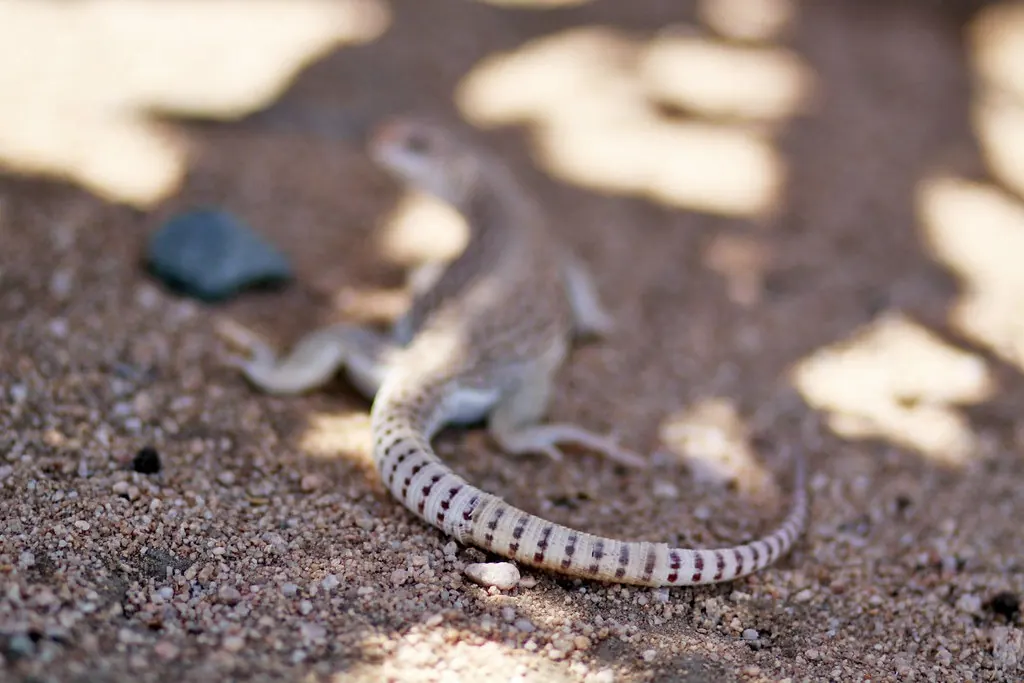
Desert iguanas have a round body, a short blunt head and a long tail that can make up more than half their length. Their backs are pale gray to cream with a net-like pattern of tan, reddish-brown or gray spots, and a single row of slightly enlarged scales runs down the middle of the back. In the breeding season, the sides of the belly can turn pinkish.
Built for Heat
Desert iguanas are among the most heat-tolerant lizards in North America. They stay active in the hottest parts of the day when many other lizards retreat. When it gets too hot even for them, they move into the shade of bushes or into burrows, often those dug by kangaroo rats or other animals. They are inactive in cooler months, spending winter underground.
Diet
Adults are mainly herbivorous. Creosote bush is a key food, and desert iguanas also eat the flowers, leaves and fruit of other desert plants, often climbing into bushes to reach blossoms. Young desert iguanas and some adults also eat insects and other small invertebrates.
Behavior and Predators
Desert iguanas are fast, wary lizards that dash for cover when approached. Predators include hawks, roadrunners, foxes, snakes and other animals. Like many lizards, they can drop part of their tail to escape a predator.
Reproduction
Breeding takes place in spring. Females lay a small clutch of roughly 2 to 10 eggs in a burrow in late spring or early summer, and hatchlings appear in late summer. Hatchlings are only about 3–4 inches long.
How Desert Iguanas Survive the Desert
Desert iguanas use several strategies to survive extreme heat and scarce water:
- Heat tolerance: they can function at body temperatures that would be dangerous for most lizards, letting them feed when predators and competitors are inactive.
- Pale color: light coloring reflects sunlight and reduces heat gain.
- Burrows: burrows stay far cooler than the surface on hot days and protect against cold at night and in winter.
- Water from food: much of their water comes from the plants they eat.
- Salt glands: like some other desert and marine reptiles, they can excrete excess salt through glands near the nose.
- Seasonal inactivity: they spend the cool months underground and become active again as temperatures rise in spring.
Desert Iguanas and Other Desert Lizards
Several other lizards share the desert iguana's habitat and are sometimes confused with it:
| Lizard | How to tell it apart |
|---|---|
| Chuckwalla | A larger, flat-bodied relative in the iguana family that lives among rocks rather than on open sand |
| Zebra-tailed lizard | Slimmer, with black and white bands under its tail, which it curls and waves |
| Desert spiny lizard | Rough, spiny scales and a darker, more mottled appearance |
| Western whiptail | Long, slender body with stripes or spots and a very long tail |
Where to See Desert Iguanas
Desert iguanas are common in suitable habitat across the Mojave and Sonoran deserts, including public lands such as Joshua Tree National Park, Mojave National Preserve and Anza-Borrego Desert State Park in California, as well as desert areas of Arizona and Nevada. Look for them on hot, sunny days in sandy flats with creosote bush, often darting between shrubs or climbing into bushes to feed on flowers. Watch from a distance, and remember that collecting wildlife in parks is prohibited.
Desert Iguanas as Pets
Desert iguanas are sometimes kept by reptile hobbyists, but they are not as common as many other pet lizards. Collecting wild desert iguanas is regulated or restricted in many states, so check local wildlife laws and look for captive-bred animals. Their care is very different from green iguana care:
| Need | Desert iguana guidance (from care guides) |
|---|---|
| Enclosure | Commonly at least about 36 × 24 × 24 in for one or two lizards, with lots of floor space |
| Substrate | Deep, clean sand or sand-soil mix for digging |
| Basking | Very hot basking area; one care guide suggests a hot side around 105°F, with the enclosure staying warm overall |
| UVB | Strong UVB, such as a T5 high-output 10–12% tube |
| Humidity | Low, dry conditions |
| Diet | Leafy greens, flowers and vegetables, plus some insects |
Because their needs are so specific, research carefully and consult a reptile veterinarian before getting one. Our lighting guide explains UVB basics that apply to all iguanas.
Desert Iguana vs. Green Iguana
| Feature | Desert iguana | Green iguana |
|---|---|---|
| Size | About 10–16 in | Commonly 4–6 ft |
| Habitat | Hot, dry desert | Humid tropical forest |
| Humidity needs | Low | High |
| Native to the US? | Yes (Southwest) | No; invasive in Florida |
Frequently Asked Questions
Where Do Desert Iguanas Live?
In the Mojave and Sonoran deserts of the southwestern US and northwestern Mexico, mostly in sandy creosote-bush habitat.
How Big Do Desert Iguanas Get?
Usually about 10 to 16 inches including the tail, which makes them one of the smallest iguanas.
What Do Desert Iguanas Eat?
Mainly plants, especially creosote bush leaves and flowers, plus some insects.
Are Desert Iguanas Good Pets?
They can be kept by experienced hobbyists who can provide a very hot, dry enclosure with strong UVB, but wild collection is restricted in many places.
Sources: Reptiles Magazine, Desert Iguana Natural History and Care; DesertUSA, Desert Iguanas; WebMD, What to Know About Desert Iguanas; Reptile Guide, Desert Iguana.