Quick Answer
- Iguanas (family Iguanidae) are mostly large plant-eaters from the Americas. Chameleons (family Chamaeleonidae) are mostly small insect-eaters, found mainly in Africa and Madagascar.
- Chameleons have independently moving eyes, a projectile tongue, grasping feet and a curling tail; iguanas have none of these.
- Both change color, but chameleons do it faster and more dramatically.
- Green iguanas grow far larger, commonly 4–6 feet, while most chameleons are under 2 feet.
Iguana vs. Chameleon at a Glance
| Feature | Green iguana | Chameleon (e.g., veiled chameleon) |
|---|---|---|
| Family | Iguanidae | Chamaeleonidae |
| Native range | Central and South America, Caribbean | Mainly Africa and Madagascar; also parts of Asia and southern Europe |
| Adult size | About 4–6 ft including tail | Most species well under 2 ft; veiled chameleon males around 2 ft |
| Diet | Herbivore: leaves, flowers, fruit | Mainly insects; some large species eat small vertebrates |
| Eyes | Normal eyes on the sides of the head | Turret-like eyes that move independently |
| Tongue | Thick, used for tasting and moving food | Long, projectile tongue to catch prey |
| Feet | Five separate toes with claws | Toes fused into two opposing bundles for grasping |
| Tail | Long, used for balance, swimming and whipping; can drop | Prehensile (can grip branches); cannot drop and regrow |
| Color change | Slow; with temperature, mood, breeding | Faster and more dramatic |
| Movement | Can run, climb and swim well | Slow, swaying walk; poor swimmers |
Color Change
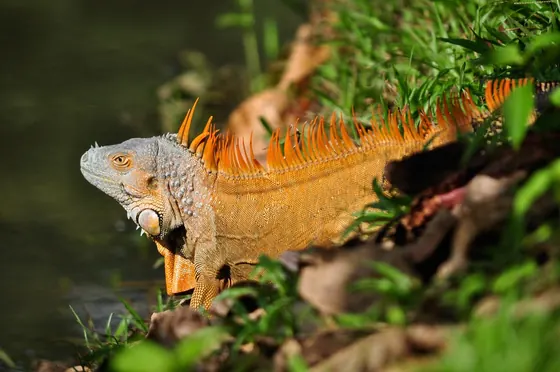
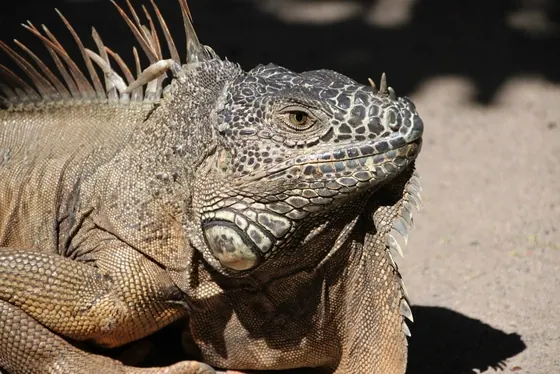
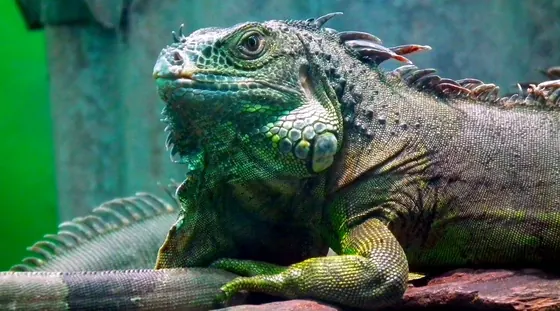
Chameleons are famous for changing color, but not mainly for camouflage. Research has shown that chameleons can rapidly change color by adjusting tiny reflective nanocrystals in their skin cells, and they use color to signal mood, communicate with other chameleons and regulate temperature. Iguanas change color too, but more slowly: darkening when cold or stressed, lightening when warm and turning orange during the breeding season. See iguana colors.
Eyes and Hunting
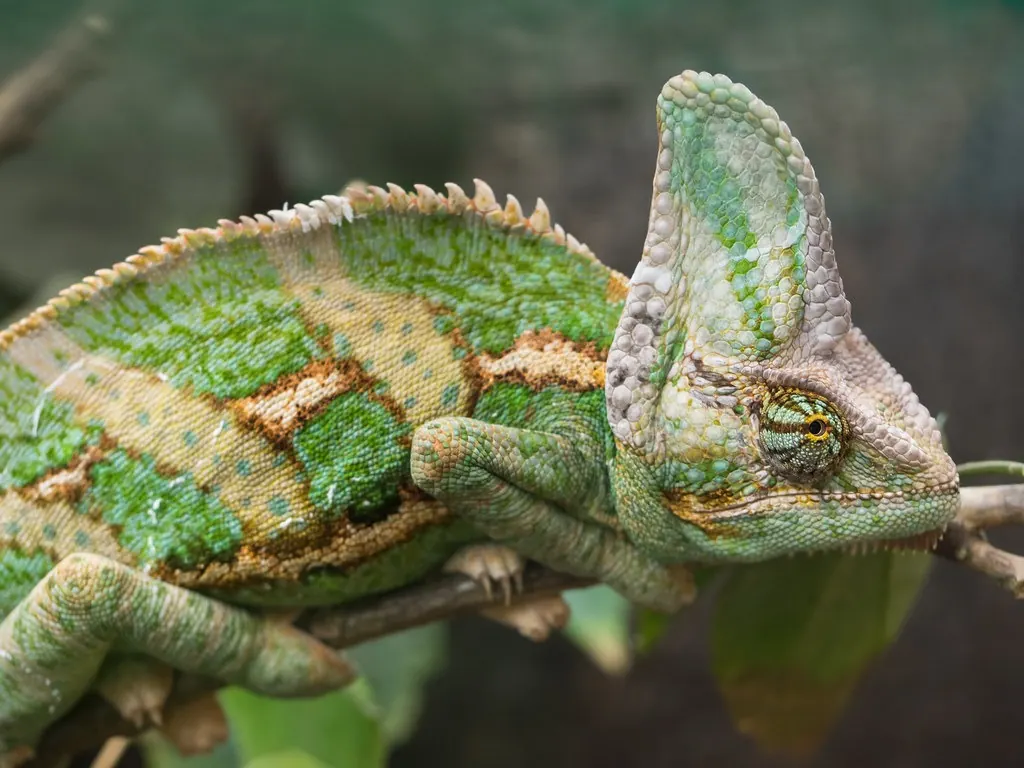
A chameleon's cone-shaped eyes can swivel independently, giving it nearly 360-degree vision, then focus together on prey. It catches insects with a tongue that can shoot out roughly its own body length at high speed. Iguanas, as plant-eaters, do not need to hunt. They have sharp color vision, including ultraviolet, and a light-sensing parietal eye for spotting predators overhead. See iguana third eye.
Feet and Tails
Chameleons have zygodactyl feet, with toes fused into two opposing groups that act like tongs, and a prehensile tail that wraps around branches. Iguanas have five separate clawed toes on each foot and a long tail used for balance, swimming and defense. Unlike chameleons, iguanas can drop part of their tail to escape predators. See iguana tail regrowth.
Habitat and Lifestyle
Both are mostly tree-dwelling, but they live on different continents. Green iguanas favor warm, humid forests near water and readily swim. Chameleons live in forests, savannas and scrub, often in bushes and trees, and rarely enter water. Chameleons are typically solitary and slow-moving, relying on stillness and swaying to avoid detection. See where iguanas live.
As Pets: Iguana vs. Chameleon
| Need | Iguana | Chameleon |
|---|---|---|
| Enclosure | Very large and tall; often room-sized for adults | Tall, well-ventilated screen or hybrid enclosure |
| Diet | Daily fresh salads | Live insects dusted with supplements |
| Water | Water dish and soaking tub | Drips and misting; many will not drink from a bowl |
| Handling | Can become tame with patient handling | Generally best as a "look, don't touch" pet; handling stresses many |
| Lifespan | Up to about 19+ years in captivity | Varies by species; often several years for popular species |
| Difficulty | High, mainly due to size | High, due to sensitivity to stress, hydration and environment |
Neither is a typical beginner reptile. For a comparison with a more beginner-friendly lizard, see iguana vs. bearded dragon, and read are iguanas good pets?
Quick Ways to Tell Them Apart
- Look at the eyes. Turret-shaped eyes moving in different directions mean chameleon.
- Look at the feet. Toes fused into two "mittens" mean chameleon; five separate clawed toes mean iguana.
- Look at the tail. A tail curled into a spiral or wrapped around a branch means chameleon.
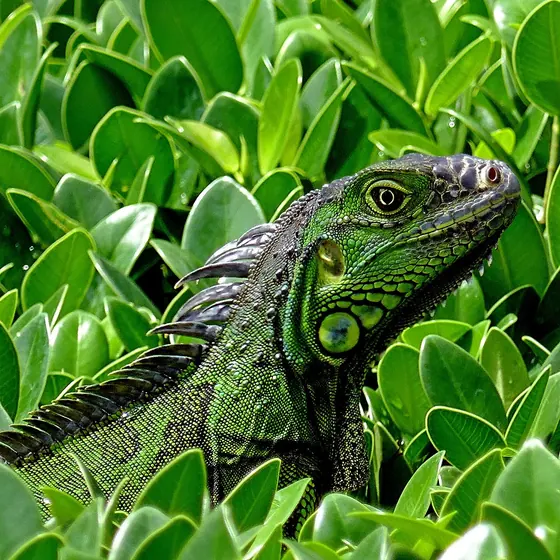
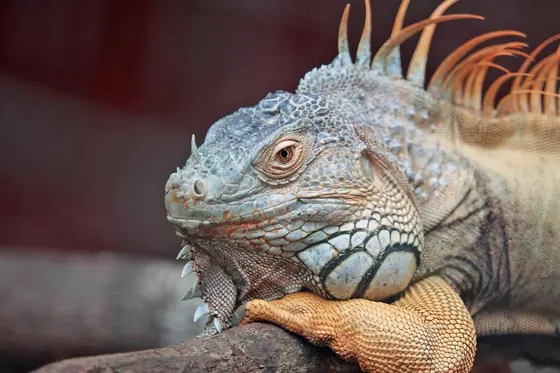
- Check the cheek. A large round scale below the ear points to a green iguana.
- Consider size and location. A 4-foot lizard swimming across a Florida canal is an iguana. (Note that veiled chameleons have also been introduced in parts of Florida.)
Conservation Status
The green iguana is widespread and listed as Least Concern, and it is invasive in places such as Florida and Puerto Rico. Many chameleon species, by contrast, have small ranges in Madagascar and Africa and are threatened by habitat loss and collection for the pet trade. Many chameleons are regulated under CITES. Many iguana species beyond the green iguana, such as the Caribbean rock iguanas, are also endangered. See rock iguanas.
Are Chameleons and Iguanas Related?
They are both lizards in the broad group Iguania, along with agamids such as bearded dragons, so they share a distant common ancestor. But they belong to different families that have evolved separately for tens of millions of years, which is why they look and behave so differently.
Frequently Asked Questions
Is a Chameleon a Type of Iguana?
No. Chameleons and iguanas are different families of lizards, though both belong to the larger group Iguania.
Which Is Bigger, an Iguana or a Chameleon?
Green iguanas are much bigger, commonly 4 to 6 feet long. Most chameleons are under 2 feet.
Can Iguanas Change Color Like Chameleons?
Iguanas change color, but more slowly and less dramatically, mainly with temperature, mood and breeding season.
Which Makes a Better Pet?
Neither is a beginner pet. Iguanas need huge enclosures and daily salads; chameleons are delicate, stress easily and eat live insects.
Sources: PangoVet, Iguana vs. Chameleon; A-Z Animals, Iguana vs. Chameleon; Teyssier et al., "Photonic Crystals Cause Active Colour Change in Chameleons," Nature Communications (2015).